
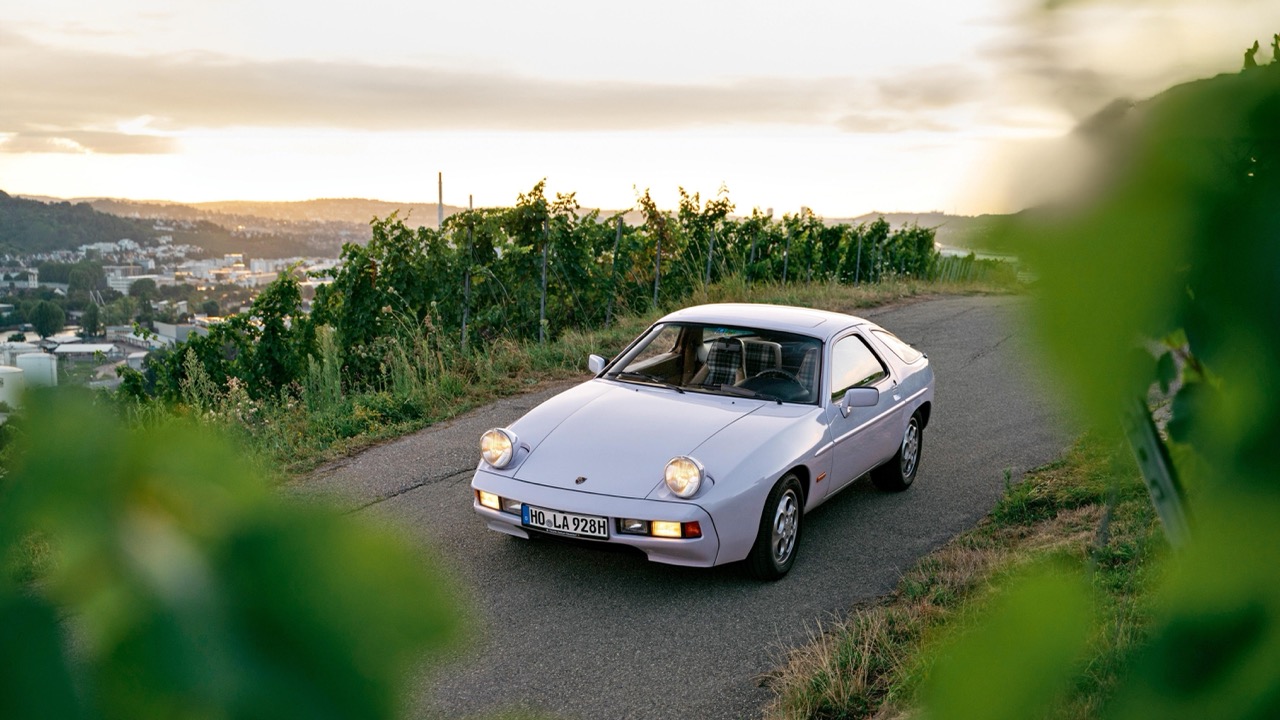
They are iconic design features of the transaxle models: the pop-up headlights. How did the new design come about?
Reaching for the rotary switch for the 928’s pop-up headlights is a typical Porsche moment of the transaxle era. The form and function of the two components perfectly complement the avant-garde style of the gran turismo. Porsche presented the sports car at the Geneva International Motor Show in the spring of 1977, thus gracing the stage of large eight-cylinder grand tourers for the first time ever. When the driver turns the headlight switch prominently positioned on the left-hand side of the cockpit to the right, the headlights shoot out of the depths of the fenders and rotate forward, bathing the road in light and enhancing visibility for the driver. Where just a moment ago the 928’s front extended seamlessly in the daylight, there are now two classic headlights illuminating the night – iconic insignia of an unforgotten sports car era.
At that time, transaxle models offered two different types of pop-up headlights. The 928 featured the forward-rotating system, while the four-cylinder models – the 924 launched in 1976 and the 944 in 1981 – were fitted with pop-up headlights that rotate backward when opening, like those of the 914 mid-engine sports car introduced in 1969. As the final stage of evolution of the transaxle models, the 968 reintroduced the design and function of the 928 headlight housings in 1991. Due to its lenses, which are also visible when the headlights are closed, the 928 is clearly different at first glance from the 924 and 944, whose headlight housings visually melt with the hood when closed, as the covers are painted in the same color as the car. The choice of design is primarily an aesthetic one. But regardless of the technology used at the front of the car, pop-up headlights began shaping the design of Porsche’s transaxle models in the mid-1970s.
Harm Lagaaij of the Netherlands, Porsche Chief Designer from 1989 to 2004, was a young designer primarily involved in the development of transaxle models 924 and 928 at that time. “It wasn’t just design and optimal aerodynamics that played a key role in development, but also the lighting technology available at that time and the laws in place back then,” he recalls. “The height of the headlights had to comply with precisely defined guidelines. But at the same time, it was clear that a bigger headlight meant better illumination with the lighting technology available back then. There was just one solution: pop-up headlights.” For many years, Lagaaij drove the 928 personally through its various stages of development. “The car has extraordinary illumination. But only because the headlights are so huge.”
In addition to the primary headlights, all transaxle models feature additional lighting functions in the bumpers. The era of pop-up headlights came to an end with the debut of the first Boxster in 1996 and the 911 of generation 996 in 1997. New lighting technology now integrates all of the functions into a single housing, while maintaining extraordinary aerodynamics. But that feeling when the raised headlights appear to extend the already long hood of a transaxle model and accompany you silently through the night is still magical to this day.
Info
Text first published in Christophorus Magazine, issue 418.
Text: Thomas Fuths
Images: Max Slobodda and Kevin McCauley
Copyright: All images, videos and audio files published in this article are subject to copyright.
Reproduction here at 928.org.uk and in the 928uk app by written consent of Dr. Ing. h.c. F. Porsche AG.


